
Can a North Bay yard feel lush without fighting every dry summer?
Yes — when water-wise is a design strategy, not a last-minute plant swap. In Napa, Sonoma, Marin, and Solano, the landscapes that hold through drought usually started with the right outdoor rooms, soil and irrigation logic, and a planting concept that matches the microclimate.
The numbers explain why. Napa averages about 26.7 inches of rain a year (NOAA 1991–2020 normals), and 83% of it falls November through March; May through September brings about an inch and a half in total. Santa Rosa is similar at about 31.5 inches. Plants here live five dry months on what the soil held from winter plus what you give them — and statewide, roughly half of household water goes outdoors (California DWR).
“Respect California” is one of the Hall Method lines: immersive and site-specific, not imported lushness that collapses when irrigation reality shows up.
Water-wise is not the same as empty
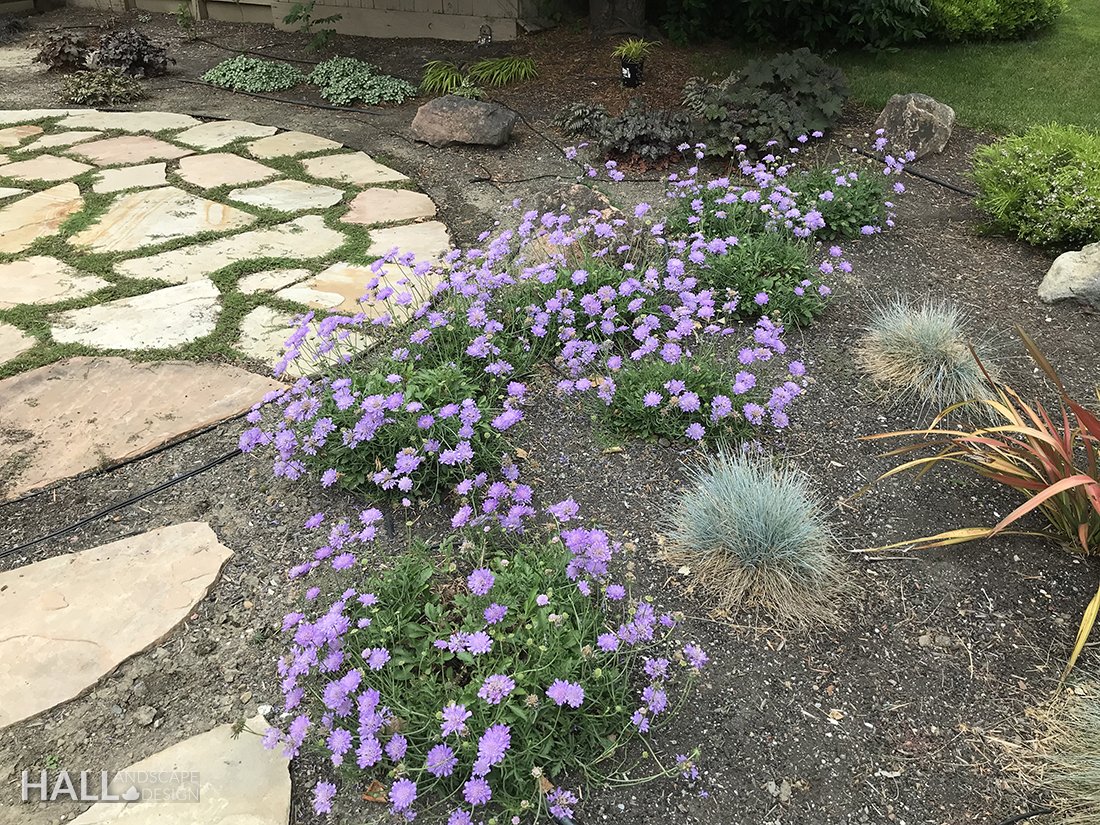
Homeowners often hear “drought-tolerant” and picture gravel and a few survivors. That is one aesthetic — not the only one. Layered planting, evergreen structure, and outdoor living can still feel generous when the plant communities and hydrozones match how the property actually behaves in a North Bay summer.
The design question is experience first: shade, movement, views from inside, places to gather. Plant selection supports that experience within climate limits — not the other way around.
Keep winter rain on the property first
Our rain arrives differently than it used to — fewer spread-out rainy days, more atmospheric-river bursts that dump inches at once and run straight downhill. Water-wise design starts there: shape the land so that winter water soaks in instead of leaving.
On a large estate I walked this September, the plan uses berms and swales to catch runoff and push it into the ground, planted with California natives that like wet feet in winter and dry summers — Berkeley sedge and Juncus patens. Every gallon the soil holds in March is one you are not buying in August. On a slope, this is the same conversation as grading and drainage — see the steep-lot guide.
A Napa lawn, gone — and nobody misses it
One of our Napa front yards was a big lawn running tree to tree, with the weeds taking over and a lot of maintenance for very little. We took the lawn out and replaced it with low-water, low-maintenance planting that still has good year-round interest — blue glow agave for structure, lantana and verbena in the sun, ajuga and hellebore in the shade — and linked the planting up tree to tree so the yard reads as one composition, not leftovers.
One detail that matters in Napa: we kept the new planting out from under the drip line of the existing oak. Native oaks are adapted to dry summers; watering under them is one of the ways a well-meaning lawn conversion hurts the best thing on the lot.
If you are in the City of Napa, its Cash for Grass program was paying $2 per square foot of lawn removed, up to $2,000 for a single-family home (plus $1 per square foot for rain gardens), as of September 2026; Marin Water’s program starts at $2.18 per square foot with higher tiers for native-heavy plantings. Artificial turf does not qualify for either. Check current terms and get pre-approval before you dig.
Mulch is the cheapest water you will ever buy
I am completely convinced of eco mulch. It keeps moisture in the soil, protects and feeds the plants, and that drives their roots deeper — which is exactly what you want going into a dry summer. It also knocks down weeds that would otherwise drink your irrigation.
If you use eucalyptus mulch, let it break down for a year or two first; it is highly acidic when fresh. California’s landscape water ordinance (MWELO) requires at least 3 inches of mulch on exposed planting soil in the projects it covers, and UC Marin Master Gardeners advise keeping mulch 6–12 inches back from trunks so the root flare stays visible.
Right plant, right exposure — heat is a tool
Microclimates shift within a single lot. Heat off the house can let you grow plants that normally would not work in that spot — sometimes citrus, like at my house. The same heat cooks the wrong plant: on a Sonoma property this fall, loropetalums jammed against a hot wall looked scraggly because they had no room to breathe. The fix was not more water. It was a better-matched mix of cactus, agave, and yucca, with the border pulled out to create real depth.
Water-wise planting worth doing is local reasoning — marine influence in parts of Marin and Sonoma, hotter inland valleys, wind, oak shade, reflected heat off walls and stone — not a generic California plant list pasted onto every lot.
Irrigation follows the design
Keeping a thirsty lawn “for the kids,” adding a tropical accent bed, then replacing whatever dies each September is patchwork under drought stress. A master plan decides what earns water — edibles and gathering areas where sun and use are, tougher planting where the view is — and groups plants by water need (hydrozones) so one valve is not watering a cactus and a hydrangea on the same schedule.
Drip beats overhead spray for most planting; California’s ordinance rates drip at 0.81 efficiency versus 0.75 for overhead spray. On rural North Bay properties with hard or well water, test the drip emitters first — mineral clogging is the quiet failure. And a weather-based controller matters more than most people think: EPA WaterSense estimates a labeled smart controller can save an average home up to 15,000 gallons a year.
The rules, briefly
California’s Model Water Efficient Landscape Ordinance (current text effective January 2, 2025) applies to new landscapes of 500 square feet or more that need a permit or plan check, and to rehabilitated landscapes of 2,500 square feet or more. It sets a residential water budget (an evapotranspiration factor of 0.55), bars turf on slopes steeper than 25% where the toe meets hardscape, and in its simplified prescriptive path caps turf at 25% of the landscape. The City of Napa follows the state ordinance; Marin Water is stricter — plan review starts at 1,000 square feet for rehabilitated landscapes, and since 2025 new single-family homes are limited to lawn on 20% of the new landscape, up to 1,200 square feet.
The state’s non-functional turf law (AB 1572) targets commercial, institutional, government, and HOA common areas — not single-family yards. Nobody is coming for your backyard lawn; the case for replacing it is cost, maintenance, and a better garden.
What this guide is not
Not a code manual or a rebate guarantee. Figures come from NOAA climate normals, the 2025 MWELO text, the City of Napa and Marin Water program pages, California DWR, and EPA WaterSense as of September 2026. Programs pause and ordinances change — confirm with your water provider and building department. We design so the landscape’s ambition matches the site’s water reality, and so you are proud of the result in August, not only in April.
How to proceed
If your yard is fighting every summer — or you are staring at a lawn you are tired of watering — start with an on-site working session. The consultation is a $300 session with Ian at Hall Landscape Design, credited toward design if you proceed. You leave knowing what earns water, what to change first, and where the winter rain should go.
Hall Landscape Design · 222 Soscol Avenue, Napa, CA 94559 · (707) 227-4931 · halldesign.info
Sources
Official pages behind the rules and figures above, checked Sep 29, 2026.
- NOAA NCEI — 1991–2020 climate normals, Napa station
- California DWR — Model Water Efficient Landscape Ordinance (MWELO)
- California DWR — outdoor share of household water use
- City of Napa — Cash for Grass
- Marin Water — Cash for Grass
- Marin Water — Landscape plan review
- State Water Board — Non-functional turf (AB 1572)
- EPA WaterSense — Labeled irrigation controllers
- UC Marin Master Gardeners — Applying mulch
Next step
Book your $300 consultation
An on-site working session on your property — credited toward design if you proceed.